

Join me and Ilyce Glink, author of the popular Love, Money + Real Estate newsletter, for a Substack Live on Wednesday, November 18 at 2 p.m. ET. Ilyce is one of my favorite radio hosts—it’s going to be a great discussion. We’ll get into today’s biggest financial headlines and what they mean for your money. Add it to your calendar here.
Imagine you’re 74, retired, collecting Social Security and taking required withdrawals from your IRA. You’ve managed your money carefully, but this year you decide to take out an extra $25,000 to replace your aging car and cover a few house extra expenses.
It’s your money that you’ve saved over decades, and now you want to use it. You’re not doing anything reckless. You’re just tapping your retirement savings for something you need.
But that withdrawal could cost you considerably more than you expect. Depending on your income, it could make more of your Social Security taxable, reduce a valuable new tax deduction, or even bump up your Medicare premiums two years from now.
And with December 31 approaching, there’s still time to figure out whether there’s a smarter way to get the money you need. The tricky part is that the tax consequences depend on how much income you already have.
Two retirees can withdraw the same $25,000 and end up with very different tax bills.
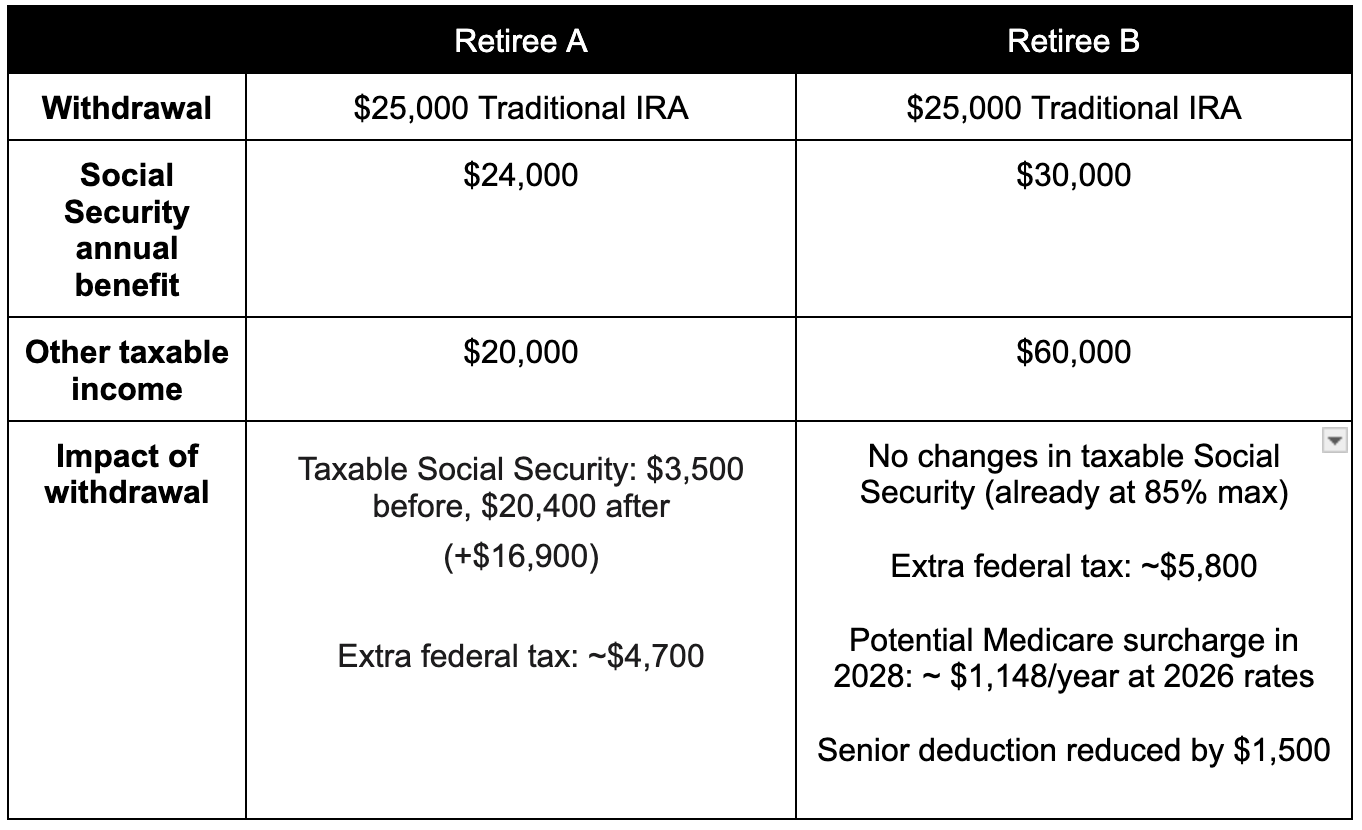
Consider two single retirees, both 74, who each take an additional $25,000 from a traditional IRA. The first retiree collects $24,000 in Social Security and has another $20,000 in taxable retirement income.
Before the withdrawal, only about $3,500 of those Social Security benefits are taxable. Afterward, that jumps to $20,400. Think about that. Taking out $25,000 has also caused another $16,900 in Social Security benefits to become taxable.
This is sometimes called the Social Security tax torpedo. Our first retiree is in the 12% federal tax bracket, but that extra $25,000 IRA withdrawal generates about $4,700 in additional federal income tax. That’s nearly 19% of the withdrawal! Meanwhile, our second retiree faces about $5,800 in additional federal income tax, or roughly 23%.
Find a vetted, fee-only fiduciary advisor at Wealthramp.
And I was surprised to find out the income thresholds used to determine Social Security taxation have never been adjusted for inflation. More retirees are getting caught by rules that haven’t kept pace with rising incomes.
Now consider our second retiree, who’s collecting $30,000 in Social Security and has $60,000 in other taxable income.
This person is already paying taxes on the maximum 85% of Social Security benefits, so the extra withdrawal doesn’t change that. But it raises adjusted gross income to approximately $110,500.
That’s where Medicare can become a problem.
A big medicare surcharge is hiding in your retirement withdrawal
Medicare looks at your income from generally two years earlier to determine whether you owe higher Part B and Part D premiums. The surcharge is called IRMAA.
For 2026, a single retiree whose 2024 income exceeded $109,000 pays higher premiums. Crossing that first threshold adds $1,148.40 a year in Medicare costs for someone enrolled in both Part B and Part D.
And Medicare doesn’t gradually increase the surcharge. Cross a threshold by even a dollar, and you owe the full surcharge for that tier.
A withdrawal made in 2026 would generally affect your 2028 premiums. We don’t know those future thresholds yet, so our second retiree isn’t necessarily headed for a surcharge. But this is exactly why you want to run the numbers before withdrawing.
One more detail: taxable Social Security benefits count toward the income Medicare uses to calculate these surcharges.
There’s a new $6,000 deduction at stake, too
There’s also a new tax break for people 65 and older that’s worth knowing about. You may qualify for an extra $6,000 deduction, but there’s a catch. It starts shrinking once your income goes above $75,000 if you’re single, or $150,000 if you’re married and filing jointly.
For every dollar over those limits, you lose six cents of the deduction.
In our second retiree’s case, that extra $25,000 withdrawal reduces the deduction by $1,500. That means another $1,500 of income gets taxed, on top of the withdrawal itself. And this tax break is only scheduled to last through 2028.
Find a vetted, fiduciary advisor to help with a one-time financial plan.
What I’d do before taking money out
First, find out what the withdrawal will actually cost. Don’t just look at your federal tax bracket. Check whether it makes more Social Security taxable, reduces your senior deduction, affects capital gains taxes or puts you near a Medicare surcharge threshold. State taxes matter, too.
Second, consider which account to tap. If you have a Roth IRA and qualify for tax-free withdrawals, that could be a better source. Qualified Roth IRA withdrawals generally require satisfying the five-year rule and, in this situation, being at least 59½. Cash savings might also be an option. You don’t necessarily need to take every extra dollar from a traditional IRA.
Third, check your required minimum distribution. If you're turning 73 this year, you can generally delay your first RMD until April 1, 2027. But that means taking two distributions in 2027. Make sure you understand the tax consequences before deciding.
Fourth, if you give to charity, consider a qualified charitable distribution. If you’re at least 70½, you can direct money from an eligible IRA to charity. The 2026 limit is $111,000 per person, and a properly executed QCD can satisfy an RMD without increasing adjusted gross income. It can’t come directly from a 401(k). Contact your custodian now if you want the distribution completed by December 31.
Finally, run the numbers with a fee-only tax planning advisor who understands retirement taxes. My Wealthramp network includes retirement income tax experts who can compare different withdrawal amounts and accounts, estimate your actual tax liability and help you avoid unintended consequences. Don’t just assume the default 10% federal withholding on an IRA withdrawal will cover what you owe.
Before you make that withdrawal, there’s one more question I’d encourage you to ask which is, “What’s the smartest way to get the $25,000 I need?”
I don’t believe retirement should be about constantly worrying whether you can afford to spend your own money. You worked really hard to save it, and the whole point was to eventually spend it. The goal isn’t to discourage you from spending your retirement savings. It’s to make sure you keep as much of that money as possible for yourself.
And it’s worth figuring out before December 31.
P.S. We’ve just launched a new MoneyTrack series, “What Good Financial Advice Looks Like.” Check it out!